fredag 13. november 2015

Fairy tales "Hansel and Gretel"


by Ann Karoline Jessen
 
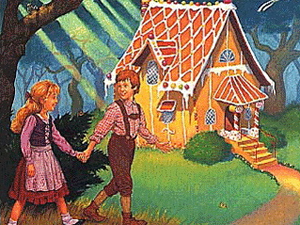
For this assignment, we were supposed to choose a topic to write about and I chose fairy tales. For this assignment I chose a fairy tale by the Grimm Brothers called “Hansel and Gretel” (Text and drawing copyright©1972 Random House, from the Pantheon book The Complete Grimm's Fairy Tales). This is a known fairy tale that I do believe a lot of children will recognize.


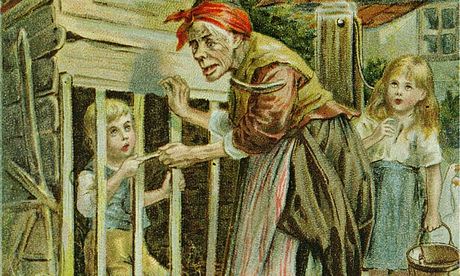
The story of Hansel and Gretel is about a poor family. The parents leaves the children out in the woods one night so they will be able to survive themselves. While looking for the trail back home Hansel and Gretel finds a house, build of bread and covered in cake, being hungry as they are they start eating. The old woman who lives in the house invites them inside. She seems kind at first but she is really a wicked witch who plans to eat them. After spending a month on fattening Hansel, she decides that the time has come and demands Gretel to help her. The wicked witch orders Gretel in to an oven but Gretel is bright enough and asks the witch to show her how it’s done. When the witch have her head inside the oven, Gretel pushes her inside and locks the door. Gretel then sets her brother free and they grab as much pearls and jewels before they head back home.


This story opens for discussion around different topics like, who to trust?, and would you have done something differently if you were the parents of the poor children?

The Grimm Brothers infused the stories they published with their own values, 19th-century middle-class culture, values and morals (Gamble, 2013 p. 142). This topic about values, morals and culture in this era would be interesting to discuss with the pupils in 6th or 7th grade. (Side note: For this to be possible, the pupils need to have and understanding and have knowledge about the topic). I would have used this text in grade 6 or 7. The text from the Grimm Brothers is a little bit on the edge, but in today society and being their age I think this text would work.


Some of the competence aims after 7th grade is “read and understand different types of texts of varying length from different sources”, “express oneself creatively inspired by different types of English literature from various sources” and “read children’s and youth literature in English and converse about persons and content”. I would use this text to both for reading and understanding because some of the language is rather old i.e. “(…) Take us across on thy back so white.” Just this piece contains a word that isn’t used anymore and that means the story can be used as a gateway to talk a little bit about the English language and even compare it to old Norwegian which is something that 7th graders have a little knowledge about. I would also use it in a creative way because it opens for creativity in many ways like drawing, arts and crafts or radio theatre. 

Sources:
Gamble, N. (2013). Exploring Children’s Literature: Reading with Pleasure and Purpose. 3rd ed. London: Sage Publications Ltd.

Utdanningsdirektoratet. (u.å). National Curriculum for Knowledge Promotion in Primary and Secondary Education and Training. http://www.udir.no/kl06/eng1-03/Hele/Kompetansemaal/kompetansemal-etter-7.-arstrinn/?lplang=eng


Picture source:

"The Sleeping Beauty"

By: Mariell Bergh Sæbø


I have chosen to write about the topic; fairy tales. For this assignment I chose the fairy tale by Charles Perrault called “The Sleeping Beauty”. I have not chosen the original tale written by Perrault, but I have chosen a shorter version of it.  It is still a known folk tale, and I believe the children will recognize it. Here’s the link to my chosen fairy tale; http://www.kidsenglishbooks.com/sleepingbeauty.pdf


Sleeping Beauty is about a young princess who was cursed to sleep for a hundred years. She got this curse when she was a new-born and her parents threw a party to celebrate her birth. They invited all of the fairies except one. The one who didn’t get invited got so angry, that she cursed the princess to die on her 16th birthday. Another fairy saved the princess by putting her to sleep until a young prince would come and awaken her.

From the text
Charles Perrault’s fairy tales always has a moral that shows a patriarchal message, and the stories were meant for the upper-class (Gamble, 2013, p.141). The moral in this tale is that there is no hurry in finding love; true love will come if you wait for it.
The text has a few old fashion words but there aren’t too many, therefor I believe the pupils will understand the text very well. An option would be to make a glossary together with the pupils so that they know what all of the words mean. It is also a familiar tale for the pupils, so I believe they would understand the meaning even if they don’t understand all of the words. There are a few pictures that are supposed to fit the text, but they are not very fitting. You can see a girl and the fairies, but it is difficult to understand what’s happening, just by watching the pictures. Also the pictures aren't very colourful. 
From the text

I believe this fairy tale would be relevant to some of the competence aims after 7th grade in Kunnskapsløftet. One of the competence aims could be; "read and understand different types of texts of varying length from different sources". For this aim the pupils could read through the text individually or in pairs, and then they could try and understand what the text is about. After this they could; "express and give grounds for own opinions about familiar topics". By doing this the pupils can discuss the folk tale and together come to a conclusion of what it’s about. The final aim I believe can be used with this tale is; "read children’s and youth literature in English and converse about persons and content", this because the children can converse about the characters and content in pairs when they have figured out what the story is about.

Sources:

  • Gamble, N.(2013). Exploring Children’s Literature: Reading with Pleasure and Purpose. 3rd ed. London: Sage Publications Ltd.


søndag 8. november 2015

Picture Books - Peter Pan

By Sandra Mikalsen.


For this assignment I have chosen the topic “picture books” and with it, a Walt Disney book from my own childhood called Peter Pan, although it can be argued to be more of a story book than a picture book. 

Peter Pan is a story about a boy who never grows up because he lives in a magic place called Never Land. He becomes friends with a girl and her two younger brothers and invites them to visit Never Land to explore some wonderful adventures. A story with at theme that many children can relate to and immerse themselves into.

The story is told by a third person, the storyteller, and contains lines for when the characters are speaking. There is quite a lot of text, primary carrying the story forward rather than the pictures, so the text does not depend on the pictures for clarification (Gamble, 2013, p.215-216). But the language is comprehensible I would argue, because it is an everyday language and even has some transparent words (Munden & Myhre, 2015, p.39-40). Also, the size of the text is big, with a lot of air between the lines and letters, and the story is divided into short paragraphs so it is easier to read for those who struggle. 

The pictures in the book is quite symmetrical to the text, because they illustrate mostly what the text is already saying and leaves little room for the imagination (Gamble, 2013, p.215). This however could be a good thing, considering how much text the book contains and that some of the words may be difficult to understand. The pictures are also very colourful, funny, filled with action, and shows clear facial expressions fitting for the events in the story. There are almost no frames surrounding the pictures, except for a few scenes where the framing is intended to emphasize a specific happening and/or to create a certain effect (Gamble, 2013, p.210). An example of this is when Peter suddenly spots a rowing boat with Captain Hook, where the picture is framed inside a circle - just like looking through binoculars.


Concerning the use of this book in teaching, I found it to be most relevant for the competence aims from the 4th year in Kunnskapsløftet. Especially aims like “find similarities between words and expression in English and his/her own native language”, because of the transparent words one can find and work with in the story. Another aim that is relevant to this book because it is a fairy tale and a story, is “understand the main content of nursery rhymes, word games, songs, fairy tales and stories”. It may be that many children are already familiar with the story, so that the pupils who has difficulties understanding may be able to transfer the Norwegian version into the English one and make some sense of it. Yet another aim is to “create own texts inspired by English-language literature and child culture” (Utdanningsdirektoratet, u.å), where the pupils could write their own ending to this book, or write something about what they would like to do in Never Land, or whether or not they would like to remain a child for ever – and why/why not?


References:
Gamble, N. (2013). Exploring Children’s Literature: Reading with Pleasure and Purpose (3rd ed.ed.). London: Sage Publications Ltd.
Munden, J. & Myhre, A. (2015). Twinkle Twinkle. 3rd edition. Oslo: Cappelen Damm Akademisk.
Utdanningsdirektoratet. (u.å). National Curriculum for Knowledge Promotion in Primary and Secondary Education and Training. Retrieved 08.11.2015, from http://www.udir.no/kl06/eng1-03/Hele/Kompetansemaal/kompetansemal-etter-4.-arstrinn/?lplang=eng